
Due Diligence on a Fragrance Partner: QC Checkpoints for Drugstore Ranges
Due diligence on a fragrance partner is mostly an exercise in deciding which claims can be verified and which can only be believed. Quality control is the area where that distinction matters most, because a shipment that fails at goods-in was usually produced by a process that was never inspected at the points that matter. The workable approach is to name the checkpoints a drugstore range depends on, then ask for the evidence each one leaves behind before a contract is signed. A supplier that can produce that evidence quickly is not necessarily better, but it is knowable, and knowable is what a buyer needs.
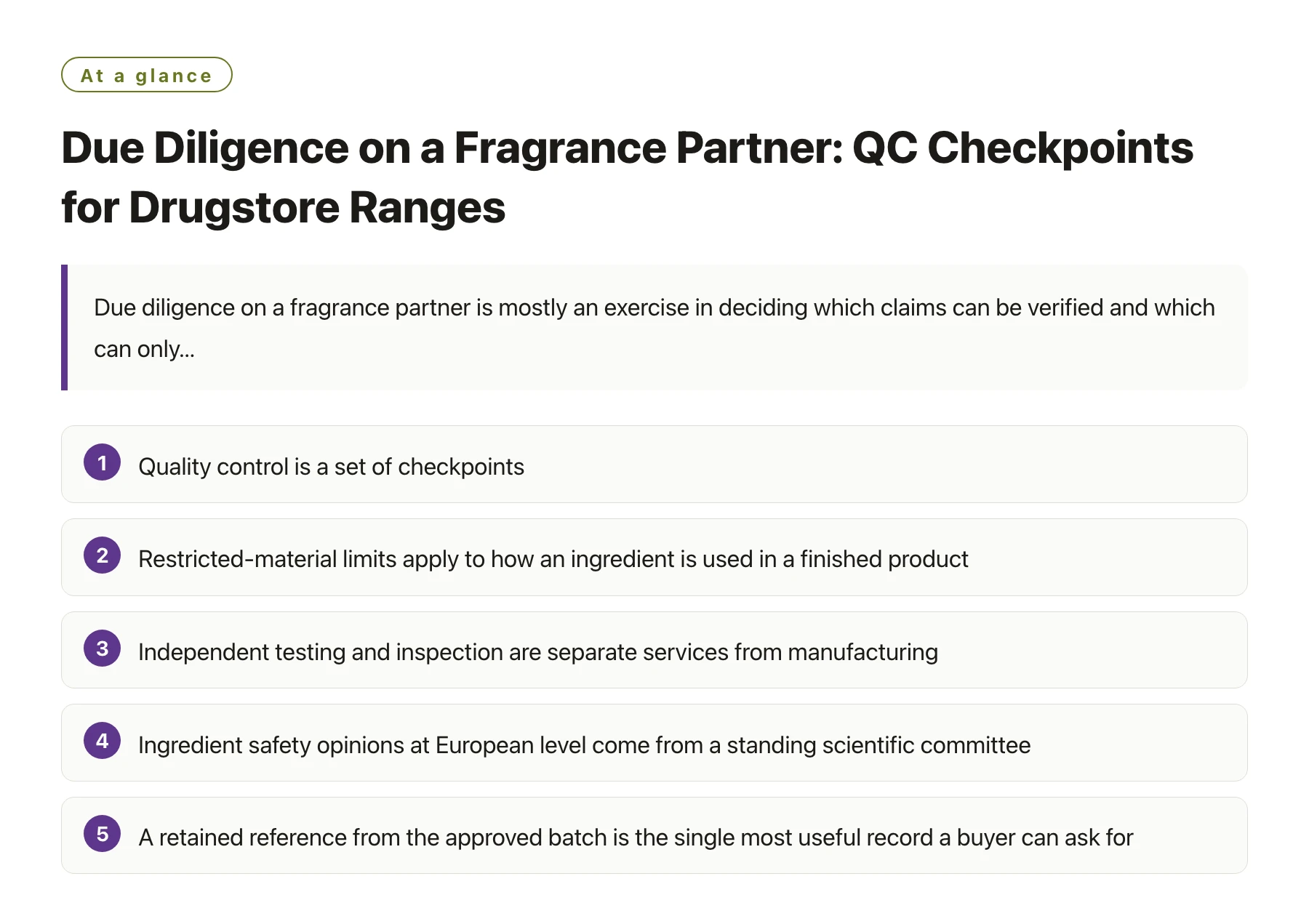
Key takeaways
- Quality control is a set of checkpoints, not a department, and a useful due diligence conversation walks through them in production order.
- Restricted-material limits apply to how an ingredient is used in a finished product, so the question to ask is about headroom in the formula rather than about a list of banned substances [1].
- Independent testing and inspection are separate services from manufacturing, which means the party that runs them should be named in writing [2].
- Ingredient safety opinions at European level come from a standing scientific committee, so a supplier should be able to point to the basis for a restriction rather than paraphrasing it [3].
- A retained reference from the approved batch is the single most useful record a buyer can ask for, because it is what a reorder is compared against.
The most expensive quality conversation a brand can have happens at goods-in, when pallets are already on the dock and the answer matters immediately. Everything that could have been discovered earlier, at the material stage, the batch record, the fill line or the pre-shipment inspection, arrives at once and arrives too late. Buyers who have lived through it tend to change how they evaluate partners, moving from a general question about quality systems to a specific walk through the checkpoints that a range will actually depend on. That shift is the beginning of real due diligence, and it is the reason a structured framework for evaluating a fragrance supplier evaluating a fragrance supplier beats a list of certificates.
The checkpoints below are ordered the way production runs, from incoming materials to final inspection. For each one there is a question to ask and a piece of evidence that should exist if the checkpoint is real. The point is not to audit the supplier yourself, which most buyers are not equipped to do, but to establish that the process is documented, owned and repeatable.
A drugstore range adds two constraints to this work. The first is volume: retail replenishment means many batches over several seasons, so consistency between batches matters more than the quality of any single one. The second is visibility: the product sits on an open shelf, where a leaking pump or a faded print is a customer complaint rather than a warehouse note.
What due diligence is actually testing
Due diligence is often described as verifying claims, but its practical purpose is to reduce the number of unknowns a buyer will be managing later. Two suppliers can both be honest and still differ enormously in how much of their process is documented, and the one with the better documentation is easier to work with when something goes wrong. That is a commercial advantage, not a moral one.
It follows that the output of due diligence should be a set of written answers and named responsibilities rather than a score. A buyer who finishes the process knowing who owns each checkpoint, what evidence it produces and how a deviation is handled has something they can use in a dispute. A buyer who finishes with an impression has only a memory.
The limits of a certificate
Certificates are useful and incomplete. They describe a management system audited at a point in time, and they do not describe the batch that is being made this week. The sensible reading is that a certificate moves a supplier onto a shortlist, while the checkpoint questions decide the order of that shortlist. Buyers should also be wary of treating certification as a substitute for the retained-reference habit, because one is about systems and the other is about the specific bottle the brand approved.
Why restricted materials deserve an early question
A formula can be compliant at one concentration and problematic at another, and the difference is not always obvious from a materials list. Asking how much headroom a candidate formula has against the relevant use limits is a normal development question, and a supplier that works with fragrance safety frameworks will answer it without drama. Asking it late, after a formula has been approved and costed, converts a technical conversation into a commercial one.
The checkpoints, in production order
| Checkpoint | What is being verified | Evidence worth asking for |
|---|---|---|
| Incoming materials | That components and concentrates match the approved specification and are released before use | Receiving records, specification sheets and the release signature for a recent batch |
| Compound and batch records | That the formula was weighed and mixed as written, at the specified concentration | A sample batch record with the weights, the operator and the supervisor sign-off |
| Fill weight and closure | That each unit holds the declared volume and that pumps and caps do not leak | In-process fill checks and a leak or vacuum test result [2] |
| Decoration and print | That print, coating and frosting meet the approved reference and survive handling | A decoration inspection record plus a retained decorated unit from the batch |
| Compatibility and stability | That the scent and the pack behave together over the intended shelf life | The test protocol, the conditions used and the conclusions drawn |
| Restricted-material position | That the formula has headroom against use limits for the product category | A statement of the limits applied and the concentration used [1] |
| Retained reference | That a reorder can be compared against what the brand approved | A sealed reference sample with its batch identity and storage location |
| Final inspection | That finished goods meet the agreed inspection standard before shipment | An inspection report naming the standard, the sample size and the result |
Read together, the evidence column is also a description of how a factory behaves when nobody is watching. Buyers who ask for two or three of these items for a recent, unrelated batch learn more than they would from a full day of presentations, and safety testing in perfume manufacturing safety testing in perfume manufacturing sits inside the same evidence chain rather than beside it.
Turning checkpoints into contract terms
The natural next step is to move the most important checkpoints into the agreement. At minimum, the contract should name the standard that final inspection follows, the retention period for reference samples, the process for handling a deviation, and who pays when a batch fails. Those four clauses cover most of the situations that give rise to disputes, and they are easier to agree before a project starts than during a launch.
It also helps to agree what happens when a component changes. Pumps, caps and cartons are the items most likely to be substituted between orders, and a substitution that is not compared against the retained reference is the quiet origin of many consistency complaints. A simple rule, that no substitution happens without a written comparison against the reference, removes a category of argument.
What to do with the answers
Once the answers are in, sort them by consequence rather than by completeness. A supplier that is strong on retained references and final inspection but weaker on decoration records may still be the right partner for a simple pack, while the reverse is true for a decorated line. The exercise is meant to match capability to the specific range, not to rank suppliers on a universal scale.
Two habits make this kind of review much easier. The first is asking for evidence from a batch that has nothing to do with your project, because a supplier prepares documentation carefully for a live enquiry. The second is putting the important questions in writing before the visit, so the answers can be compared across suppliers instead of remembered. A prepared list of the questions to ask a perfume factory is worth more than a longer tour, and a manufacturer that offers their OEM/ODM manufacturing services as a defined programme will usually have those answers ready.
Sources
- IFRA: Safe Use and Fragrance Science —— IFRA's explanation of how fragrance materials are scientifically assessed for safe use and how those conclusions are applied by the industry.
- SGS: Cosmetics, Personal Care & Household Testing —— Testing, inspection and certification services for cosmetics and personal care, including microbiological, stability and safety testing aligned with cosmetics GMP.
- EU Scientific Committee on Consumer Safety (SCCS) —— The EU scientific committee that issues opinions on the safety of cosmetic ingredients, including fragrance allergens and their labelling thresholds.
Frequently asked questions
What quality documents should a buyer request before signing with a fragrance manufacturer?
Ask for a sample batch record, in-process fill and leak check results, a decoration inspection record, the stability and compatibility protocol, a statement of restricted-material headroom, the retained-reference procedure and the standard used for final inspection. Two or three of these from a recent batch say more than a folder of certificates.
Can quality be judged without visiting the factory?
Partially. Documents and records can be reviewed remotely, and they reveal whether a process is documented and repeatable. What cannot be judged remotely is whether the records reflect what happens on the floor, which is why a visit still has value for any range intended to run beyond one season.
How long should a supplier retain a reference sample?
Long enough to cover the commercial life of the product plus any reasonable claims period. The exact figure is a contractual matter, but the important points are that a sealed reference exists, that it is identifiable by batch, and that it is stored so it can be retrieved and compared.
What is the difference between a certificate and a batch record?
A certificate describes a management system audited at a point in time, while a batch record describes how one specific production run was made, weighed, filled and checked. Due diligence needs both, and the batch record is the one that speaks to the goods being shipped.
How should deviations be handled in a fragrance order?
They should be recorded, signed off by a named person and disclosed to the buyer with a proposed disposition. The contract should also state who carries the cost when a deviation is rejected, because that question is far easier to settle in advance than in the middle of a shipment.